|
||
35. Globular silicates |
| Listing of Structures |
| Back...Next |
| Meteorite - Tucson, ungrouped iron. |
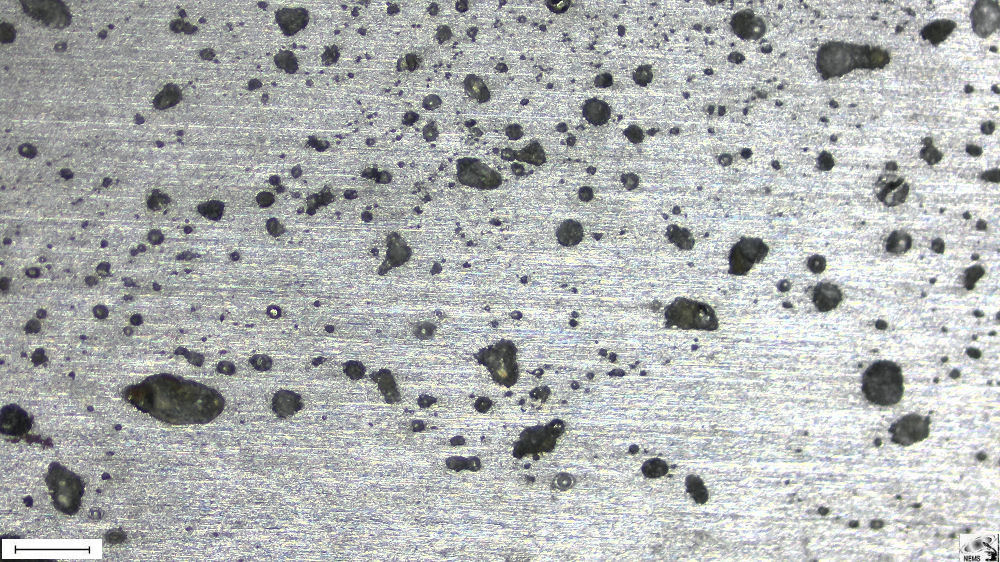
| Figure 1. Scale bar 300 µ. |
| Meteorite: Tucson, Iron, Ungrouped |
| Silicate inclusions in the Tucson Iron |
| Figure 1. Silicate inclusions in the Tucson (ungrouped) iron meteorite. Scale bar: 300 µm. Figure 2. Detailed view of silicate inclusions. Scale bar: 150 µm. Globular silicates The Tucson iron meteorite (also known as the Tucson Ring) is a highly distinctive ungrouped iron characterized by a fine ataxitic structure and an unusually high abundance (~8 vol%) of silicate inclusions. These inclusions are arranged in prominent flow-like, subparallel patterns within the metallic matrix, reflecting dynamic emplacement processes during or after incorporation. Petrography and Mineralogy The silicate inclusions are predominantly globular and consist of highly reduced mineral assemblages, including forsteritic olivine (Mg-rich), nearly pure enstatite (low-Ca pyroxene), aluminous diopside (Ca-pyroxene), pure anorthite (plagioclase), and accessory phases such as brezinaite (Cr3S4). The metal phase itself contains dissolved silicon and chromium, further underscoring the reduced conditions of formation. Petrogenesis These globular silicates are interpreted as primary nebular features. According to detailed studies (e.g., Kurat et al.), the silicates and associated metal likely formed through high-temperature processes in the solar nebula gas, possibly involving condensation, evaporation, or co-precipitation under intense thermal conditions reaching approximately 1,500–1,800 °C. This origin is unrelated to conventional igneous differentiation on a parent body. The flow-like alignment suggests subsequent deformation or flow within a partially molten or plastic metallic matrix. Buchwald (1975) described Tucson as “an exceptionally unusual ataxite, exhibiting a flow pattern of subparallel silicate crystals, predominantly olivine,” noting that it lacks close structural or compositional analogs among other known iron meteorites. Its ungrouped status reflects a unique combination of reduced silicates embedded in Si- and Cr-bearing metal, making it a valuable specimen for understanding non-equilibrium processes in the early Solar System. The presence of such well-preserved globular silicates in an iron meteorite highlights rare mechanisms of metal-silicate mixing that differ markedly from typical impact or differentiation scenarios observed in other silicate-bearing irons. |
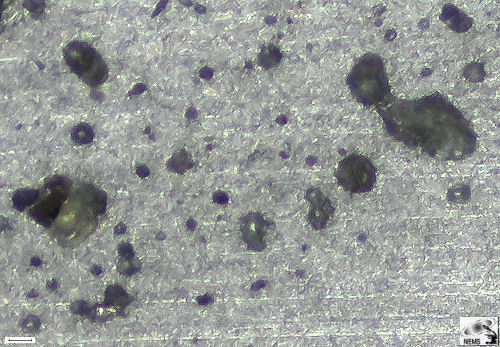
| Figure 2. Scale bar 150 µm. |
| Meteorite: Tucson, Iron, Ungrouped |
| Globular clusters and silicate structures. |
| References |
| • Buchwald, V. F. (1975). Handbook of Iron Meteorites. University of California Press. • Kurat, G., et al. (2010). The Tucson ungrouped iron meteorite and its relationship to chondrites. Meteoritics & Planetary Science. • Additional studies: Friedrich et al. (2021) on 3D petrography; earlier works on Tucson’s reduced silicates. • Meteoritical Bulletin Database. |
| Listing of Structures |